
Menopause Body Changes
Oct 27, 2026
Why Is My Body Changing During Perimenopause, and What Should I Do Differently?
You're eating much the same way you always have. You're staying active, perhaps even exercising more than before. Yet your clothes are fitting differently, you're carrying more weight around your middle, your energy isn't what it used to be, and recovery seems to take longer.
Sound familiar?
For many women in their 40s and 50s, these changes can be frustrating, especially when the things that worked before don't seem to be producing the same results.
Naturally, we start looking for answers.
Is it estrogen? Cortisol? Has my metabolism slowed down? Should I be fasting, lifting heavier weights, or doing more Zone 2 cardio?
There's no shortage of advice, but there is a shortage of context.
As a Registered Kinesiologist, Clinical Exercise Physiologist, and board-certified Health and Wellness Coach, I've spent more than 25 years helping people understand their bodies and develop healthier lifestyles.
One thing I've learned is that we often underestimate how much the fundamentals influence our health, especially when we're distracted by the latest trends and promises.
Does Your Metabolism Really Slow Down During Perimenopause?
One of the most common explanations for midlife weight gain is that our metabolism suddenly slows down as we approach menopause.
But the research tells a more interesting story.
A major study published in Science in 2021 examined energy expenditure across the human lifespan. The researchers found that when adjusted for body size and composition, daily energy expenditure remained relatively stable between approximately 20 and 60 years of age, with a gradual decline occurring later in life.
That doesn't mean our bodies aren't changing.
During perimenopause, fluctuating reproductive hormones can affect sleep, symptoms, and wellbeing. Changes in estrogen are also associated with shifts in fat distribution, particularly toward the abdominal region.
At the same time, our activity levels, muscle mass, stress, recovery, eating patterns, and daily responsibilities may be changing.
These factors can influence how much energy we use, how we feel, and how our bodies respond to the things we do.
So rather than assuming your metabolism is broken, it's worth looking at the bigger picture.
Why Your Body Composition, Energy, and Recovery May Be Changing
Body composition involves more than your weight
As we move through midlife, changes in muscle mass and fat distribution can influence how our bodies look and feel, even without a dramatic change on the scale.
Preserving muscle through appropriate resistance training, regular physical activity, and adequate nutrition becomes increasingly important.
But that doesn't mean every woman needs the same workout or should push herself harder.
Your current fitness level, health, preferences, schedule, and recovery capacity all matter.
Sleep and recovery deserve more attention
Sleep is often one of the first things women notice changing during perimenopause.
Night sweats, disrupted sleep, stress, and competing demands can affect how rested we feel and how much energy we have available for physical activity and everyday life.
When we're tired, maintaining regular exercise and making thoughtful food choices may become more difficult.
Sometimes the most useful adjustment isn't adding another workout. It's improving the conditions that allow us to recover.
And when sleep disturbances are persistent or related to significant menopause symptoms, appropriate medical care can be an important part of the solution.
Our eating habits may have changed without us realizing it
We tend to focus on what we're eating, but how and when we eat can also be worth exploring.
I once worked with a woman around age 40 who was struggling with weight gain and low energy.
As we discussed her daily routine, we identified a pattern of grazing throughout the day.
Rather than introducing a complicated diet, we discussed creating more structure around her meals and giving herself time between eating occasions.
She began making those adjustments and lost 16 pounds over three months.
Her experience doesn't mean everyone should eat fewer meals or that meal spacing alone causes weight loss. Her overall energy intake may also have changed.
What it demonstrates is the value of examining our existing habits before assuming we need an entirely new strategy.
For someone else, the answer might involve eating more consistently, improving meal quality, or addressing an unhealthy relationship with food.
That's why I don't believe fasting or any particular eating schedule should be prescribed as the answer for every woman.
Do You Need to Change Everything During Menopause?
No. And I think this is something we need to talk about more.
We're constantly exposed to headlines about cortisol, estrogen, supplements, fasting, exercise intensity, and the latest strategies for managing menopause.
Some recommendations are supported by good research. Others are exaggerated, taken out of context, or marketed as solutions to problems that are much more complex.
It's easy to begin questioning ourselves.
Am I exercising the wrong way? Eating at the wrong time? Am I making things worse without realizing it?
We can become so focused on finding the perfect strategy that we lose confidence in what we already know about our own bodies.
The reality is that the fundamentals of lifestyle medicine remain important throughout midlife:
-
Regular movement that includes cardiovascular activity and muscle-strengthening exercise
-
Nourishing, mostly whole foods that provide adequate energy and nutrients
-
Sleep and recovery that support physical and mental wellbeing
-
Healthy relationships, meaningful social connections, and stress-management skills
-
Sustainable habits that fit our lives and can be adjusted as our needs change
These aren't particularly exciting headlines.
But they are the foundation on which long-term health is built.
And understanding how to apply them to your circumstances is often more valuable than finding another health trend to follow.
Where Should You Start if Your Old Routine Isn't Working?
Before changing everything, consider asking yourself a few questions.
-
Has my daily activity changed, even though I'm still exercising regularly?
-
Am I getting enough sleep to feel rested and recover from my activities?
-
What does my eating pattern actually look like throughout the day?
-
Am I choosing exercise based on my current goals and capabilities, or simply continuing what I've always done?
-
Am I giving myself enough time to notice whether a change is helping before moving on to something else?
You don't have to answer all of these perfectly.
The purpose is to start identifying what deserves your attention.
From there, choose something realistic to work on, give yourself an opportunity to observe the results, and adjust as needed.
And remember, not every symptom should be attributed to menopause. Persistent fatigue, unexplained weight changes, or significant changes in health deserve an appropriate medical assessment.
How Can the Midlife Wellness Reset Help?
This is exactly why I developed the Midlife Wellness Reset, an eight-week education and wellness coaching program designed for women navigating the changes of midlife.
It's not a diet, a supervised workout program, or another set of rigid rules to follow.
It's an opportunity to better understand what's happening in your body, consider what matters most to your health, and develop habits that make sense for your life.
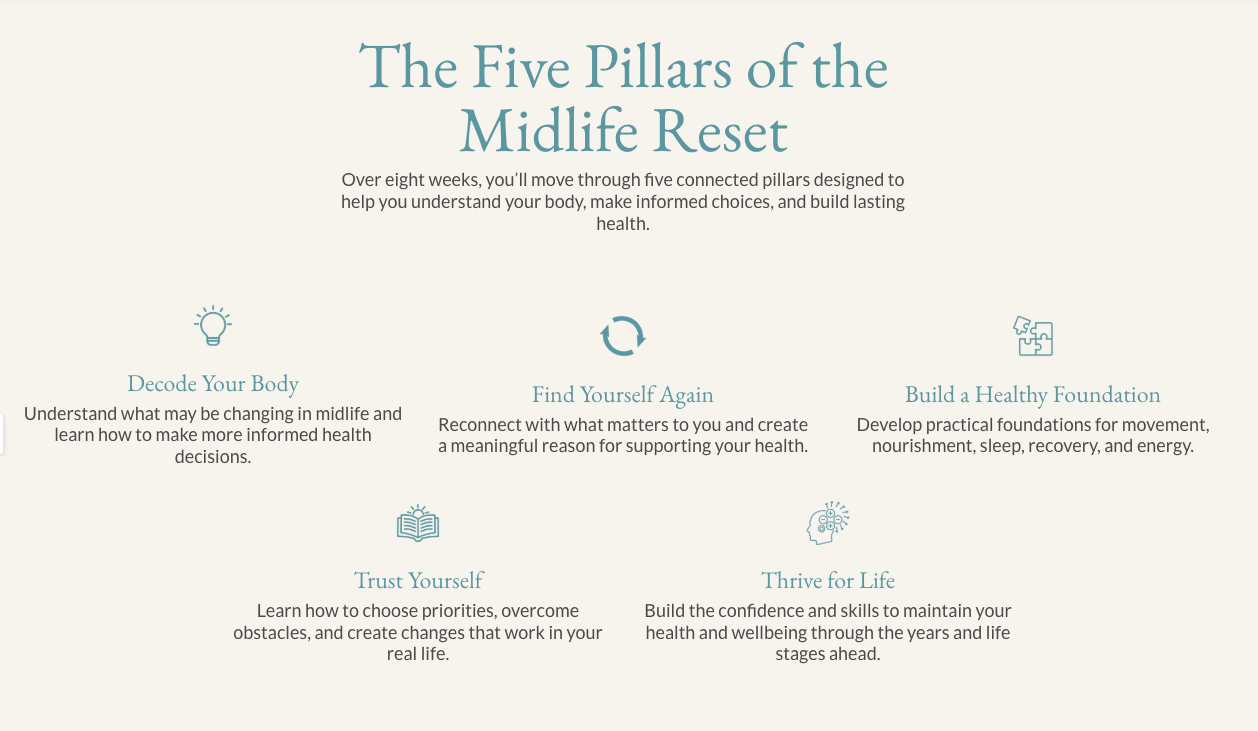
We work through five connected areas:
-
Decode Your Body: Understand midlife changes and learn to evaluate health information with greater confidence.
-
Find Yourself Again: Reconnect with your priorities, values, and the reasons you want to care for your health.
-
Build a Healthy Foundation: Explore movement, nourishment, recovery, and the lifestyle factors that support wellbeing.
-
Trust Yourself: Develop behaviour-change skills so you can make decisions, follow through, learn from your experiences, and adapt.
-
Thrive for Life: Create a personal wellness blueprint that supports your health beyond the program.
My hope is that women leave the program not only knowing more, but feeling more capable of making decisions for themselves.
That might mean sleeping better, making food choices with greater confidence, becoming more consistent with physical activity, or making progress toward healthier body composition.
These are worthwhile goals, although individual results will vary and meaningful changes in body composition may take longer than eight weeks.
The bigger goal is to develop an approach to health that you understand, trust, and can maintain.
Your Midlife Health Doesn't Have to Be Defined by Confusion
Your body is changing. That's part of life.
But those changes don't mean you need to abandon everything you know or spend the next decade trying to keep up with the latest wellness advice.
We have a substantial body of evidence about the lifestyle behaviours that support health, physical function, and wellbeing as we age.
What matters is learning how to apply that knowledge to the body and life you have today.
If you're ready to understand your changing body, build a healthier foundation, and feel more confident about what you're doing, I invite you to explore the Midlife Wellness Reset.
Learn more about the Midlife Wellness Reset at Mindy Gulas Kinesiology & Wellness, or book a conversation to discuss your health goals.
Research and Further Reading
-
Pontzer H, et al. (2021). Daily energy expenditure through the human life course. Science.
-
International Menopause Society. Recommendations and Key Messages on Women's Midlife Health and Menopause.
-
Liu HY, et al. (2024). Meal Timing and Anthropometric and Metabolic Outcomes: A Systematic Review and Meta-Analysis. JAMA Network Open.
If this topic interests you and you would like to know more, please look further at the information and programs available, or book a call to ask your specific questions!
How 'well' are you doing?
Try this quick wellness assessment for an overview of how well you are managing your mind and body with work and life! Once you finish, reach out to Mindy for a complimentary coaching chat.
We hate SPAM. We will never sell your information, for any reason.
